
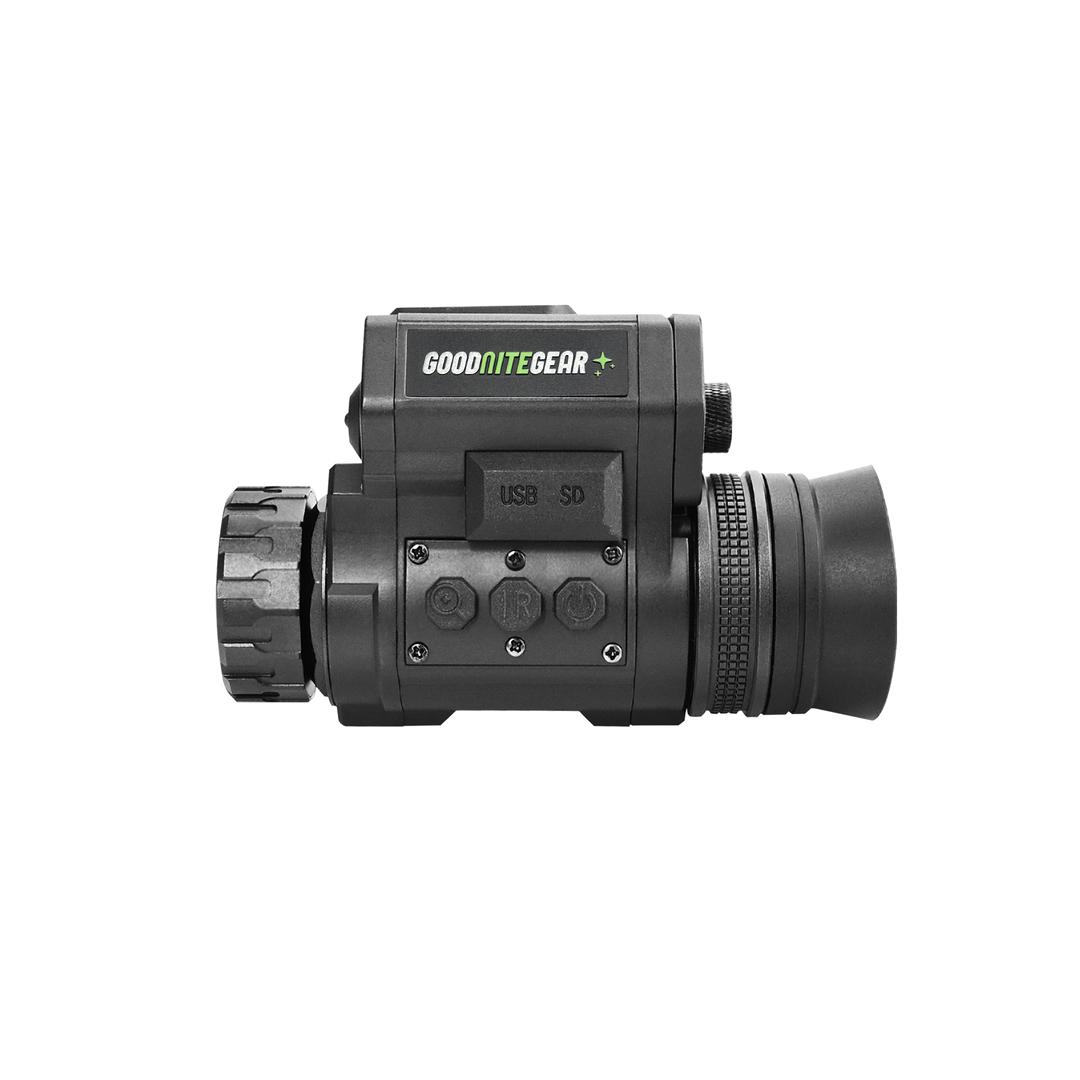



If you've been watching the digital night vision space, you already know things have shifted dramatically over the last couple of years. The NVG90 SE is a prime example of where digital NV stands today — and at $1,700, it's forcing some serious questions about whether premium analog is still worth the price premium. In this review, we're putting it up against Gen 2+ analog tubes, the Sionyx Opsin, the NVG90 Pro, and a couple of budget digital devices to show you exactly what you're getting and where it sits in the market. The NVG90 SE is a reband of the ADNV G14SE. Good Nite Gear has a special partniership with ADNV that makes this possible.
What Is the NVG90 SE and What Does It Cost?
The NVG90 SE retails for $1,700 on goodnitegearshop.com. Use coupon code US10 at checkout and that drops to just over $1,529 — which makes this decision even easier when you start comparing it to the competition. More on that shortly.
NVG90 SE Full Specs Breakdown
The specs on this device aren't just numbers — they directly explain why it performs the way it does in real-world conditions.
Sensor: The NVG90 SE runs a ⅔-inch DG1102-1 2nd Gen high-performance sCMOS sensor with a minimum illumination rating of 0.0001 lux. That's an extraordinarily low light threshold — we're talking near-total darkness territory. The sensor is paired with an ASIC main control chip for high frame rate performance, low latency, and efficient power draw.
Display: Same as the NVG90 Pro — an 800×600 OLED display running at up to 100Hz. The image is smooth, real-time, and genuinely clear. If you've looked through cheaper digital night vision with a laggy, smeared image, this is a completely different experience.
Field of View: 50 degrees at 1x magnification — wide and usable for situational awareness in a monocular form factor.
IR Illuminator: Built-in, but you likely won't need it in most conditions. Any moonlight or ambient light source and the sensor handles it without IR. The illuminator is there for true blackout environments.
External Recording: A 9-core aviation socket allows connection to the optional RS2 external recording device (sold separately). The capability is built in — you just need the accessory to use it.

Battery Options and Runtime
The NVG90 SE gives you two power configurations depending on your mission length.
The standard tube takes a CR123A or 16340 battery and delivers approximately 5 hours of runtime at 100Hz. Step up to the extended tube with an 18650 battery and you're looking at up to 16 hours at 100Hz. Drop to 50Hz and you get even more runtime — plus a meaningful boost in brightness in very dark conditions, which we'll cover in the comparison section below.
For law enforcement, security, or anyone running overnight operations, the 18650 configuration is the way to go.
Mounting and Configuration Options
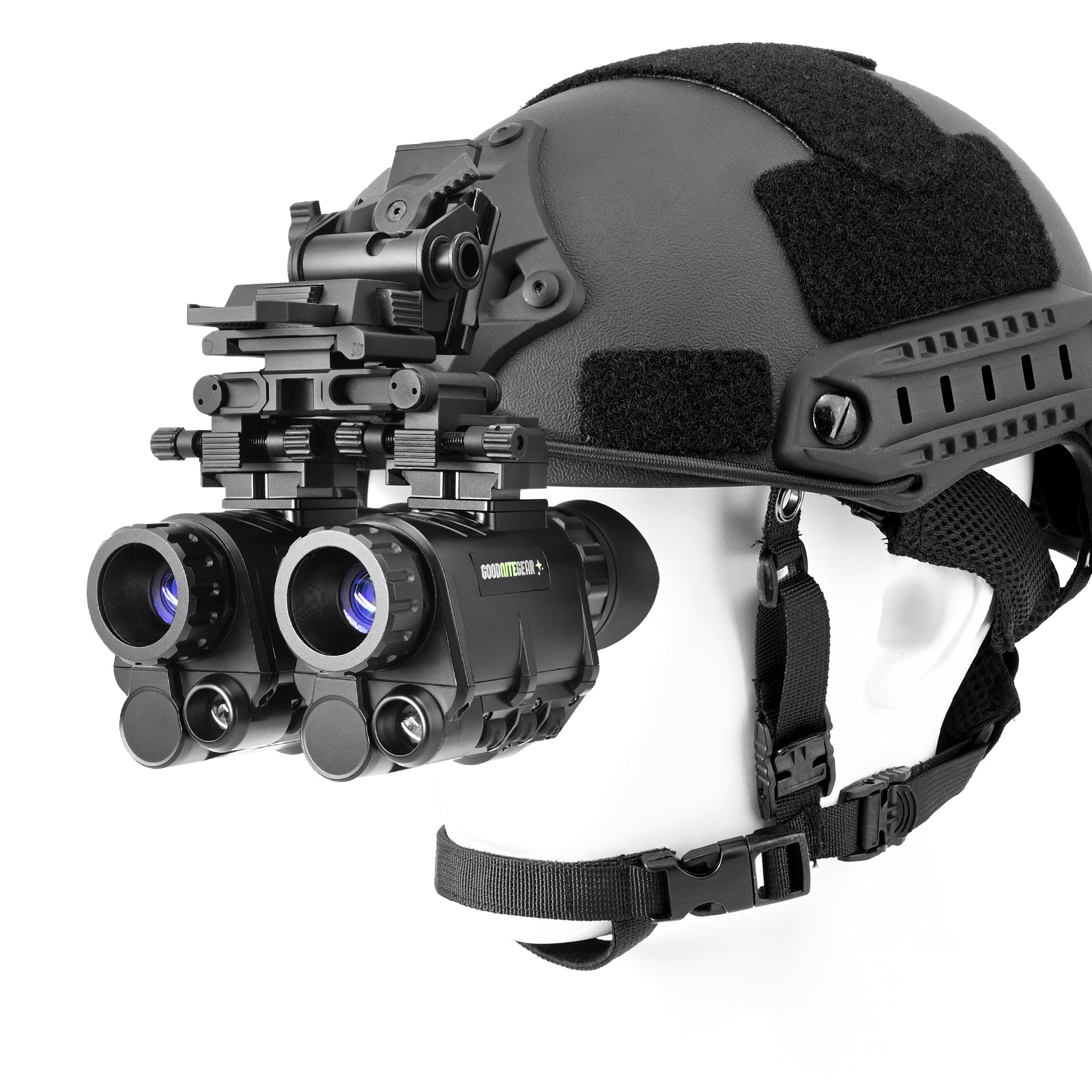
The NVG90 SE ships with a G24 mount compatible with standard helmet and head mount systems, with hardware to run it over either eye. It also includes everything needed to bridge two units into a dual binocular setup — a significant upgrade for depth perception and situational awareness. That's worth its own deep-dive video, but if you can stretch the budget to run two, it's a noticeably better experience.

NVG90 SE vs Gen 2+ PVS14: How Close Is It Really?
The comparison photos here were taken through a Google Pixel 7 in a garage across four progressively darker lighting levels — no supplemental IR, just ambient light. The analog reference was a Gen 2+ NVT White Phosphor PVS14, purchased for approximately $2,499 plus shipping.
At the brighter lighting levels, the two devices are strikingly similar. The PVS14 edges ahead in raw brightness and contrast as conditions get darker, which is expected — it's a more expensive tube. But the NVG90 SE picks up more peripheral detail and offers a slightly wider field of view, which matters in real operational use.
Switch the NVG90 SE to 50Hz and the gap closes further. The image gets significantly brighter in low light — still not quite at Gen 2+ analog levels in the darkest conditions, but genuinely close. For anyone who doesn't want to spend $2,500 or more on a new PVS14, the NVG90 SE at 50Hz is a very credible alternative.

NVG90 SE vs NVG90 Pro vs Sionyx Opsin
This is the three-way digital comparison most buyers are going to care about.
The NVG90 Pro (~$2,800) shares nearly the same design as the SE but carries a larger 1-inch sensor versus the SE's ⅔-inch. At 100Hz in moderate lighting, the two devices are very close. It's not until the fourth and darkest lighting level that the Pro's sensor advantage becomes clearly visible. For most users in most conditions, the SE is going to be plenty.
The Sionyx Opsin (~$2,000) runs a color XQE-1351 sensor at 90FPS and was widely considered the top digital night vision option until recently. Against the NVG90 SE, it simply isn't competitive anymore. The SE outperforms it at every brightness level, and in the darkest test conditions the Opsin displayed nothing — the SE still had a usable image. One honest note: color sensors do have some advantages when lighting is better, since color contrast can make certain objects easier to spot. But from a pure low-light performance standpoint, black and white sensors win, and the SE wins this comparison convincingly.

The conclusion here is direct: at $1,529 with the US10 code, there's no reason to buy the Sionyx Opsin anymore.
NVG90 SE vs NVG50 vs Nightfox Prowl 2: How It Compares at Lower Price Points
This comparison answers the "how much does spending more actually matter?" question.
The NVG50 (~$500) is a solid device for its price point — its low-light performance actually tracks fairly closely to the Sionyx Opsin, which says something about the Opsin's value proposition. But against the NVG90 SE, the gap is immediately obvious. The SE runs at a significantly higher frame rate and holds a cleaner, brighter image as lighting drops.
The Nightfox Prowl 2 (~$250) is further behind and highly dependent on IR illumination to perform in dark conditions. It's a beginner entry point, not a real comparison to the SE.

The takeaway: with digital night vision, you do get what you pay for. The jump from $500 to $1,529 is real and visible.
Outdoor Performance
With around 13% lunar illumination and decent cloud cover, the NVG90 SE produced extremely bright, detailed outdoor imagery — everything clearly visible and easy to navigate. In a denser canopy environment blocking direct moonlight — tested alongside a Gen 3 Elbit PVS14 — the SE returned clear water detail and fine background foliage with no IR assist.
Against a Gen 2+ PVS14 in heavy canopy conditions, the SE held its own with crisp imagery even on shadowed surfaces like tree trunks.
Who Is the NVG90 SE Built For?
- Law enforcement who need a capable night observation tool at a realistic budget without the lead time of a full analog procurement
- Military personnel and veterans looking for a capable digital alternative to an analog tube for training or personal use
- Airsoft and mil-sim players who want a helmet-mountable device with smooth, high frame-rate imagery that performs in low-light scenarios
- Security professionals running extended shifts who need flexible power options and reliable performance
- Outdoorsmen and preppers who want serious night vision capability without spending $2,500+ on analog
- Night vision enthusiasts ready to step up from budget digital gear and see what a high-performance sensor actually delivers
NVG90 SE vs NVG90 Pro: Which One Should You Buy?
If you're deciding between the SE and the Pro, here's the honest answer: most users will be well served by the SE. The performance gap only becomes meaningful in the darkest possible environments. If you're operating in areas with any ambient light — streetlights, partial moonlight, artificial sources — the SE is going to handle it. The Pro earns its price for users who need every bit of low-light advantage in true blackout conditions.
Save the $1,000+ difference and put it toward a second unit for a binocular setup, or toward other gear.
Final Verdict
The NVG90 SE is the best value in performance digital night vision monoculars right now. It delivers Gen 2+ competitive performance at well under the cost of a new analog tube, runs at a smooth 100Hz on a clear OLED display, handles multiple power configurations for short or extended operations, and outclasses the Sionyx Opsin at a lower price point. Whether you're coming from budget digital gear looking to upgrade, or evaluating digital versus analog for the first time, this is the device that makes the strongest case.
Ready to grab one? Check out the NVG90 SE on goodnitegearshop.com and use code US10 to save 10% at checkout — bringing it down to just over $1,529. Want to see how it compares to the rest of the lineup? Browse the full digital night vision collection to find the right device for your use case and budget.

