



NVG90 vs. PVS-14: How Close Has Digital Night Vision Really Gotten to Analog?
For years, the story on digital night vision has been "good, but not analog good." We put that claim to the test head-to-head: the NVG90, a $1,250 digital night vision monocular, against a Gen 2+ PVS-14, a $2,500 analog monocular — twice the price. Across low light, bright light, latency, spectral range, and real wooded terrain, we wanted a straight answer to a simple question: how much of that gap has actually closed, and where does each device still win?
The Devices
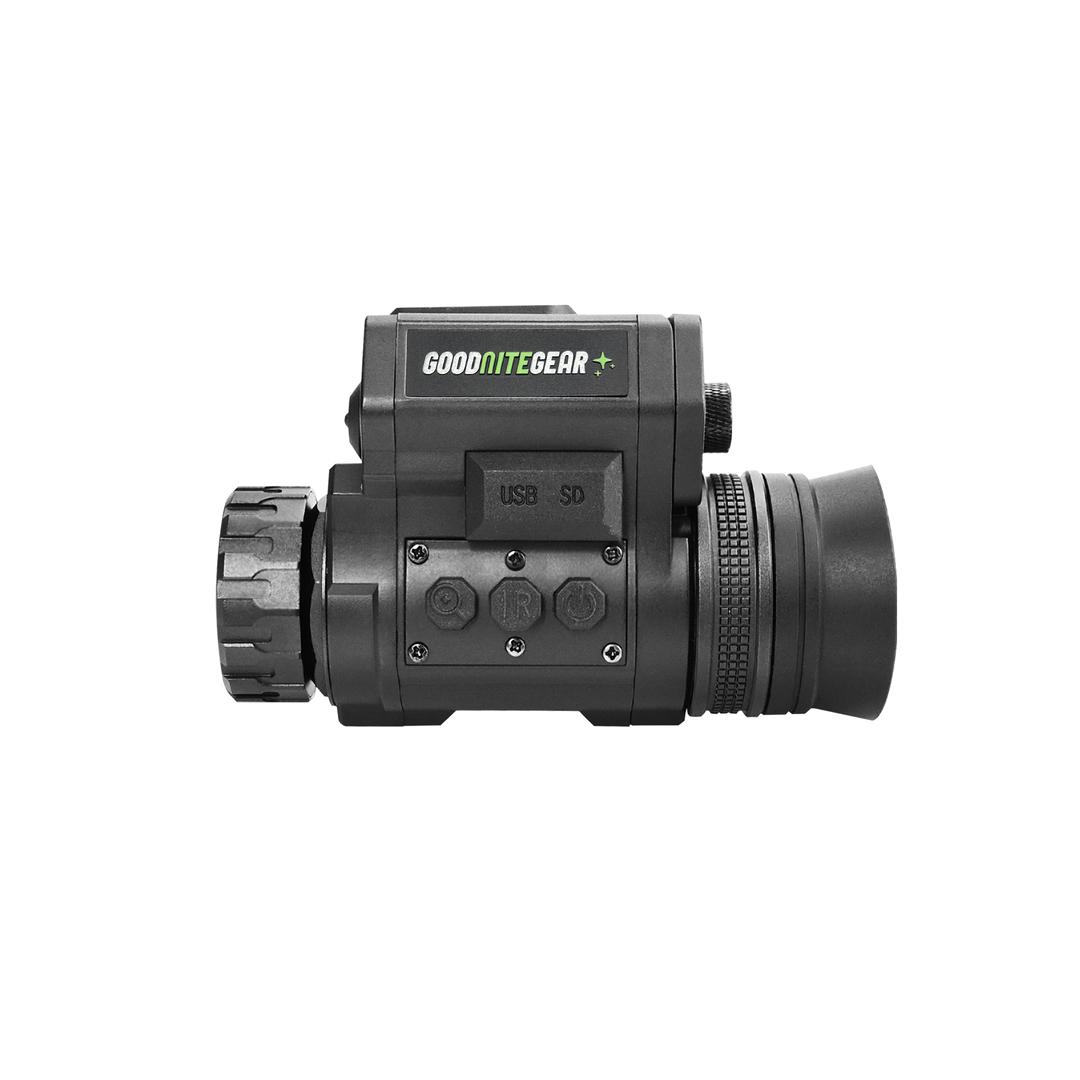
Weight and size-wise, these two are nearly identical. The NVG90 comes in at 12.3oz to the PVS-14's 11.8oz, and they're close in overall length too — this isn't a case of digital being bulkier or heavier to get comparable performance.

Battery life is where analog still has a clear edge. The PVS-14 runs up to 50 hours on a single AA battery — about as common and lightweight as batteries get. The NVG90 runs 6–8 hours on a single 18650, depending on brightness, recording, and IR settings. Advantage analog, no question. That said, the NVG90 has a charging port for topping off on the go, and 18650s are increasingly common in tactical flashlights, so sourcing spares isn't the obstacle it once was.
Digital zoom is a standout NVG90 feature analog simply doesn't have. A rotating zoom knob gets you up to 5x magnification with a crisp image — real-time close-up ID on distant targets without swapping optics or losing field of view. That's wide-area situational awareness and long-range ID in a single unit. The PVS-14 is locked to one fixed magnification.
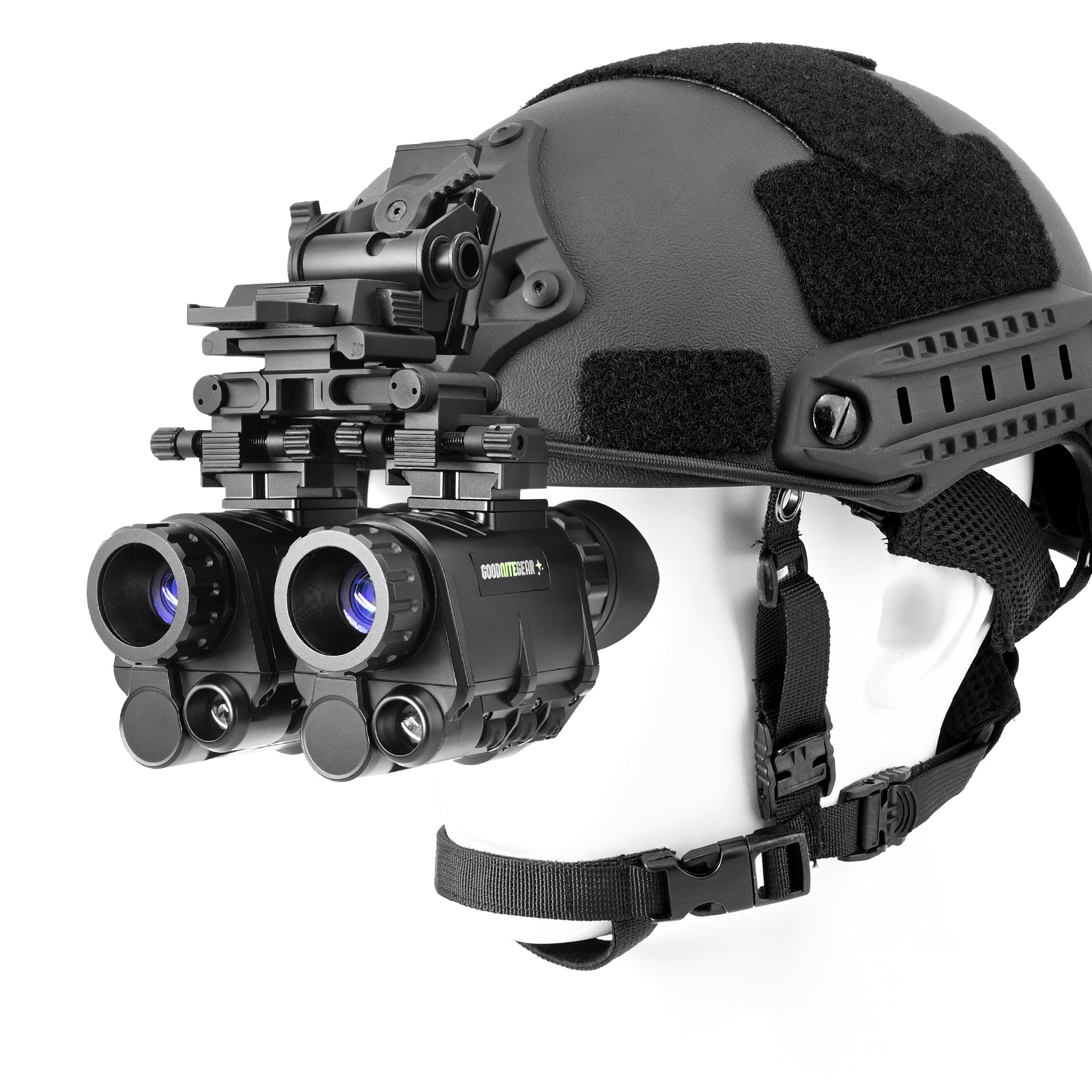
The NVG90 also ships with a Z04 Wilcox dovetail mounting arm compatible with a standard night vision mount, and two units can be bridged together for a binocular setup with real depth perception.
Low-Light Performance
We ran a stepped-lighting test in a garage, tracking a target roughly 7 meters out, from the NVG90 at its max 100FPS framerate against the PVS-14, both sitting at a comparable ~40° field of view — with a simulated naked-eye reference alongside for context.

The unaided-eye reference fell apart almost immediately as light dropped. The NVG90, by contrast, kept pace with the Gen 2+ PVS-14 step after step — and even in the darkest condition tested, it was still holding its own, with zero IR illumination assistance in play. No supplemental lighting, no shortcuts. For a device at half the price of the PVS-14, that's a genuinely strong result.
If detection capability on top of navigation matters for your use case, that's the gap thermal fusion is built to close — see our thermal fusion devices.
Bright-Light Exposure
This is a category where the gap hasn't just closed — it's flipped entirely in digital's favor. Expose a powered-on PVS-14 to a bright light source and you risk damaging or outright destroying the image-intensifier tube. It's one of the most well-documented vulnerabilities of analog night vision, and it's a real cost risk for anyone using a tube-based device around headlights, muzzle flash, or unpredictable lighting.

The NVG90 has no equivalent failure point. There's no tube to burn out — you can run it into direct light sources without risking permanent device damage.
Latency
Zero processing lag has always been analog's strongest card — light hits a tube and you see it in real time, full stop. Digital used to trail noticeably behind here. That's no longer the case with the NVG90: processing is fast enough now that the delay isn't perceptible in real-world use, whether you're moving fast, driving, or clearing a space. Digital has effectively closed this gap.
Spectral Range
Both devices pick up standard IR aiming lasers and illuminators — that's baseline functionality for any night vision device. But the NVG90's wider spectral response range catches things the PVS-14 misses entirely. In our testing, an iPhone's Face ID infrared flash was completely invisible to the PVS-14, while the NVG90 registered it clearly every time. In practical terms, that means a phone being pulled out nearby is far more likely to register as a flicker of light on digital than on analog — a small but real edge in situational awareness.
Real-World Terrain
Lab and garage tests only tell part of the story, so we took both units into wooded terrain — genuinely difficult conditions for any night vision system, with broken light, heavy shadow, and leaf clutter that makes picking out movement hard.
Under a dense canopy with zero moonlight — about as dark as this environment gets — both units still performed well, a strong result given there was essentially no ambient light to work with. Moving to areas with open moonlight exposure, both devices clearly resolved distant objects. Even under a waxing gibbous moon at 79% illumination — close to best-case lighting for either system — both held up as expected.

The real takeaway from the terrain test isn't the moonlit shots, where good performance is expected of nearly any device. It's that both units performed comparably under that dense, light-starved canopy, where there was next to nothing to work with.
The Verdict
Does the gap actually close? After running the NVG90 and a Gen 2+ PVS-14 head-to-head across low light, bright light, latency, spectral range, and real terrain — yes, more than most people expect.
The PVS-14 is still the gold standard for raw analog performance, and if budget isn't a constraint and battery life is your top priority, it remains an excellent choice. But at less than half the price, the NVG90 matched it step-for-step across nearly every category we tested — and pulled ahead outright in a few places analog simply can't compete: zoom versatility, bright-light durability, and spectral detection range.
For most buyers getting into night vision — and even experienced users looking for a more versatile, budget-conscious option — the NVG90 makes a serious case for itself against a device costing twice as much.
Frequently Asked Questions
Is digital night vision as good as analog now?
For most practical use cases, modern digital night vision like the NVG90 performs competitively with Gen 2+ analog tubes like the PVS-14 in low light, and actually outperforms analog in bright-light durability, digital zoom, and spectral detection range. Analog still holds a clear edge in battery life and has effectively zero processing latency, though digital has closed that latency gap significantly.
What's the main advantage of the PVS-14 over digital night vision?
Battery life is the PVS-14's biggest advantage — up to 50 hours on a single, widely available AA battery, compared to 6–8 hours on the NVG90's 18650 battery. The PVS-14 also has zero processing latency by nature of being a pure optical system, though digital latency is no longer perceptible in real-world use.
Can bright light damage a PVS-14?
Yes. Exposing a powered-on image-intensifier tube to a bright light source is a well-documented failure point for analog night vision and can permanently damage the tube. Digital night vision devices like the NVG90 don't have this vulnerability since there's no tube to burn out.
Shop the NVG90 Digital Night Vision Monocular — use code US10 for 10% off. For detection capability layered on top of night vision, check out the GF20 Thermal Fusion Monocular or GF31 Thermal Fusion Binocular.

