
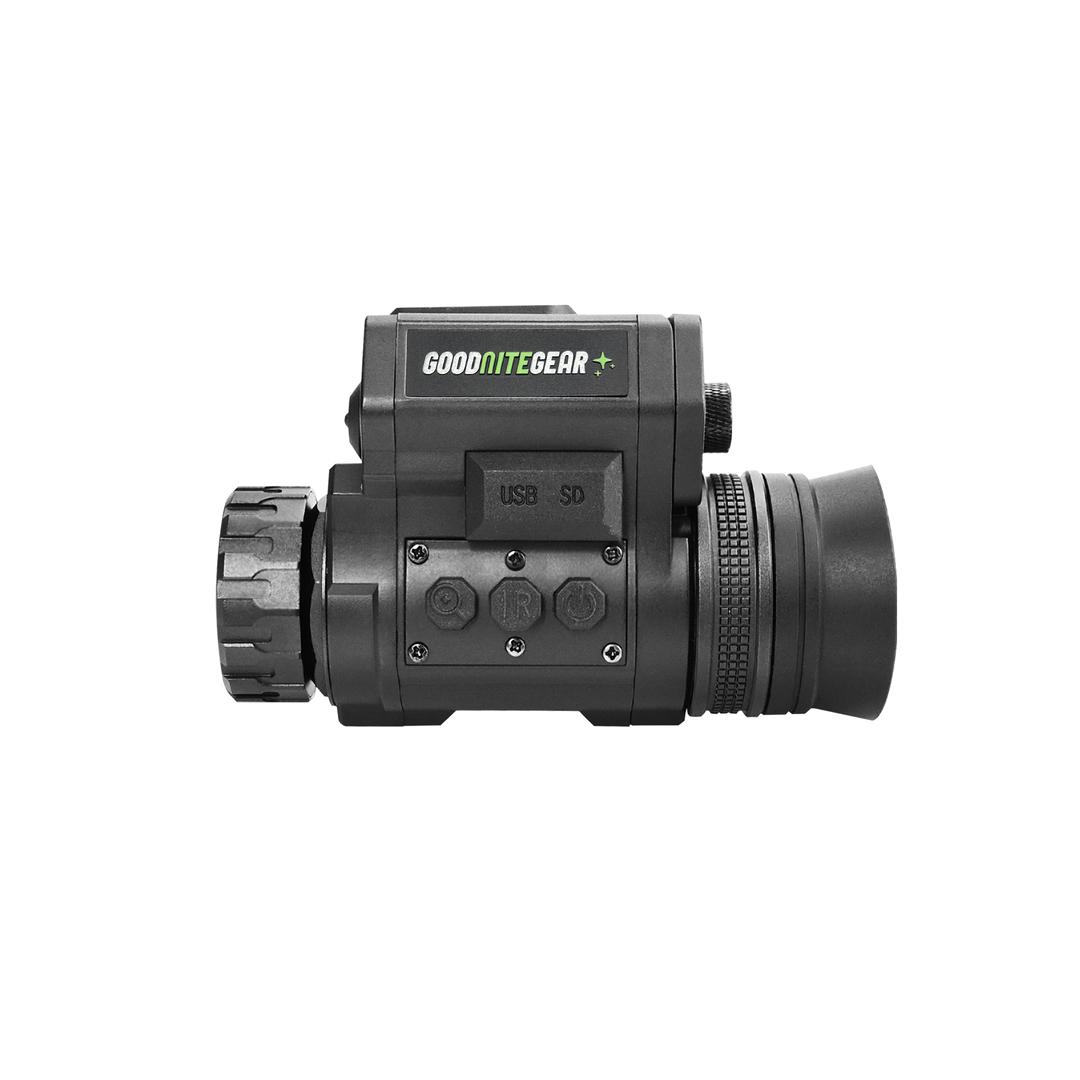

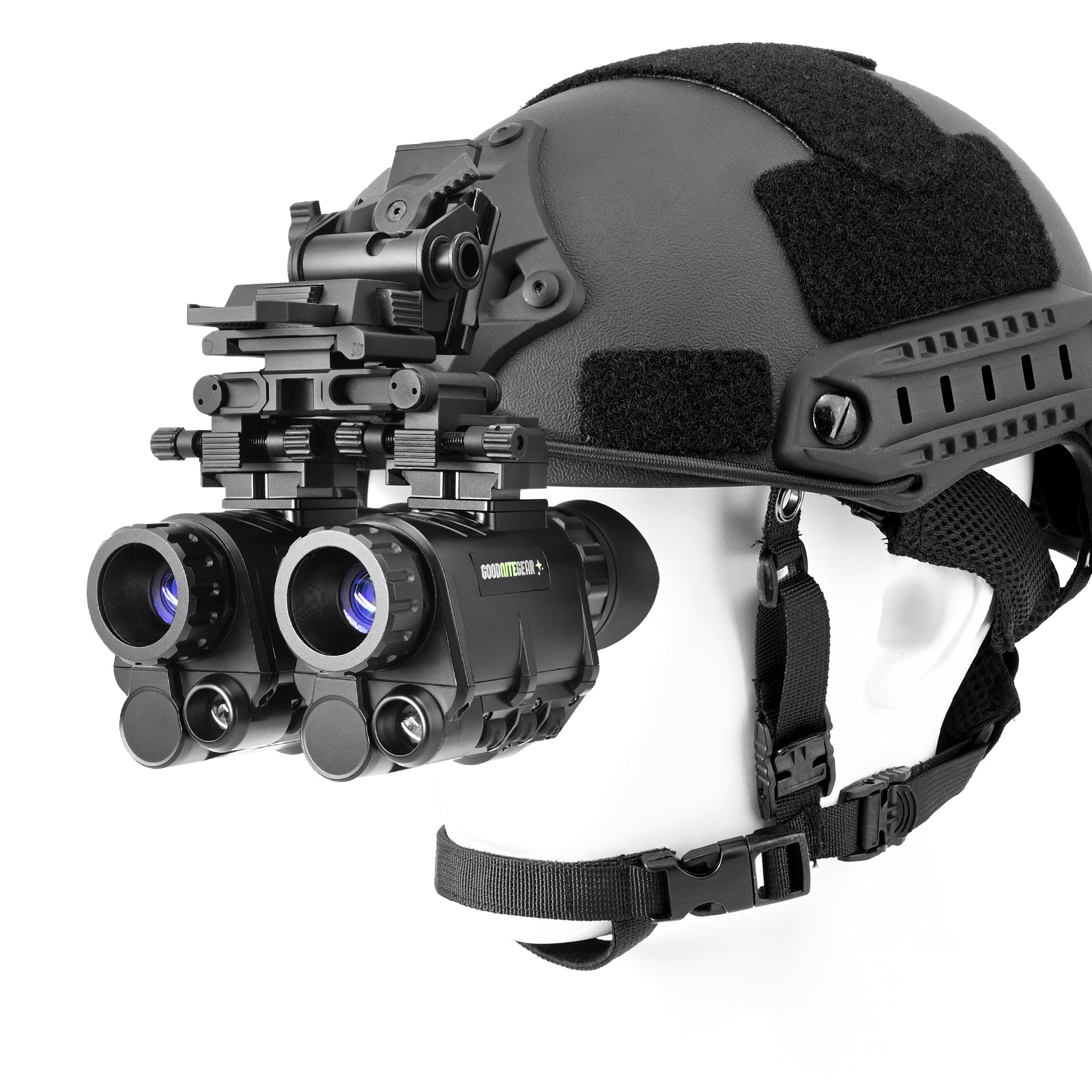


This is a $999 digital monocular going head-to-head with a $3,400 Gen 3 Elbit PVS-14 — a device that costs more than three times as much. The question we're answering isn't "which one's better." It's whether digital has actually closed the gap on analog, and if so, by how much.
For most of night vision's history, the answer to "digital vs. analog" has been a pretty confident "analog wins, no contest." By the end of this breakdown, you'll see exactly where that's still true — and where digital has genuinely bridged the gap.
Quick Comparison
| SVG5 | Gen 3 PVS-14 | |
|---|---|---|
| Price | ~$999 | ~$3,400 |
| Weight | 10.2 oz | 12.1 oz |
| Sensor | 1" progressive scan CMOS, 18μm pixels, 0.0001 lux | Gen 3 image intensifier tube |
| Display | Micro OLED, 800×600 | N/A (direct optical) |
| Power | Single 18650, 4–6 hours | Single AA, ~50 hours |
| Weatherproofing | IP67, submersible to 1m for 30 min | — |
| Digital Zoom | Up to 5x | None (fixed magnification) |
| Bright Light Damage Risk | None | Real risk to the tube |
The Rundown
Before testing, it's worth getting acquainted with both devices. The first thing that'll surprise you: how physically similar they are. The SVG5 comes in at 10.2 oz against the PVS-14's 12.1 oz — length and overall footprint are basically a wash.

Under the hood, the SVG5 runs a 1-inch progressive scan CMOS sensor with 18-micron pixels, rated down to 0.0001 lux, paired with a high-res Micro OLED display at 800×600. Power comes from a single 18650 battery, good for roughly 4–6 hours depending on the cell. The PVS-14, by comparison, runs 50 hours on a single AA — and AAs are about as cheap and easy to carry as batteries get. This one's a clean win for analog.
The SVG5 doesn't have onboard charging, so you'll want an external charger and a couple of spare 18650s in your kit. What it does have going for it: IP67 dust and water resistance (submersible to 1 meter for 30 minutes), a metal housing that punches well above its price point, and a dovetail arm that fits any standard NV mount.
One feature the PVS-14 simply can't touch: the SVG5's digital zoom knob. Twist it and you get up to 5x magnification with a clean image — real-time ID on distant targets without swapping optics or sacrificing your wide field of view. Analog is locked to one fixed magnification, period.
A quick filming note: to create a more consistent viewing experience, most of the footage in this comparison is shot through the eyepiece of each device using an iPhone 17e. Our "naked eye" reference footage comes from an Insta360 One R, dialed in to approximate real human low-light vision.
Indoor Garage Test
First up: a side-by-side in stepped lighting, target sitting about 7 meters out, tracking how the SVG5 compares to the PVS-14 — and how both compare to the naked eye — as the light drops. The SVG5 runs at its max 100FPS, with both units set to roughly the same 40° field of view.

The simulated human-eye footage is essentially useless from the start. The SVG5, on the other hand, stays right there with the Gen 3 PVS-14 through nearly every step, only easing back slightly in the darkest conditions tested — and even there, it's still fully usable. Keep in mind: no IR illuminator, no supplemental lighting, nothing propping it up. For a device at roughly a third of the price, that's a legitimately strong showing.
Since we're on the subject of low light — if detection matters as much to you as visibility does, that's the whole premise behind thermal fusion. The GF20 monocular and GF31 binocular both pair a night vision sensor with a 640×512 thermal core, running in outline mode or full fusion. We've also got a dedicated video comparing digital thermal fusion to analog thermal fusion if you want to go deeper on that topic.
Bright Light Test
Here's a gap that hasn't just closed — it's completely reversed. Point a bright light source at a powered-on PVS-14 and you risk damaging the image intensifier tube. It's one of the most well-known weak points of analog night vision.

The SVG5 has no such vulnerability. Headlights, flashlights, whatever you throw at it — there's no tube to damage.
Latency
Latency has always been analog's built-in advantage — zero processing delay, photons hitting a tube in real time. Digital used to lag noticeably behind here. That's changed. The SVG5 processes fast enough now that the delay isn't something you perceive in real-world use — running, driving, clearing a room, doesn't matter. It's keeping pace with analog in real time, which is honestly one of the more impressive jumps digital has made in recent years.
Wooded Area Test
Now we take both units where a lot of you will actually be using them — hunting, scouting, land navigation after dark. Wooded terrain is a genuinely tough environment for any NV system: broken light, deep shadow, and enough branch and leaf clutter to make picking out movement legitimately hard.
We start under a dense canopy with zero moonlight — about as dark as this location gets — and both units are still resolving usable detail, despite having next to no ambient light to work with.

From there we move to an area with some moonlight exposure, and both devices pick up a car in the background clearly.
Finally, we're in direct moonlight under a waxing gibbous moon at 79% illumination — and unsurprisingly, both perform well here. With that much light available, this is close to a best-case scenario for either system, so the real story of this test isn't the moonlit footage — it's that both devices held their own under that near-black canopy where there was almost nothing to work with.
Final Thoughts
So does the gap actually close? After putting these two through low light, bright light, latency, and real terrain, the honest answer is: yes — more than most people expect.
The PVS-14 is still the gold standard, and if budget isn't a concern and battery life is your top priority, it's still the safe pick. But at under a third of the price, the SVG5 matched it step for step across nearly every test here — and pulled ahead outright in a few places analog simply can't compete: zoom versatility, bright-light durability, and expanded detection range through fusion.
For anyone getting into night vision for the first time — or experienced users looking for a more versatile, budget-conscious option — the SVG5 makes a genuinely strong case for itself. If you've been on the fence about whether digital has actually caught up, this comparison should put that question to rest.
We've also got the SVG5 in a separate comparison going head-to-head against a few other devices in the $1,000–$2,000 range — the NVG90, NVG90 SE, and Sionyx Opsin — and it held up well there too, if you want to check that one out.

