



The Best Digital Night Vision Under $1,000: GNG SVG5 Review
Finding genuinely capable digital night vision under $1,000 has always meant accepting real compromises — in low-light performance, build quality, or both. The GNG SVG5 changes that equation. After real-world testing and head-to-head comparisons against devices costing nearly twice as much, it's the strongest sub-$1,000 digital night vision option on the market right now — and the performance gap between it and significantly more expensive hardware is smaller than it has any right to be.
Here's the full breakdown.
Build Quality: A Step Above the Price Tag
The first thing you notice about the SVG5 is that it doesn't feel like a budget device. The housing is full metal construction with an IP67 rating — that means it's dust-tight and can handle submersion up to one meter. Most digital night vision in this price range tops out at IP54 or IP65. IP67 is a meaningful step up and it tells you something about how this device is built to be used.
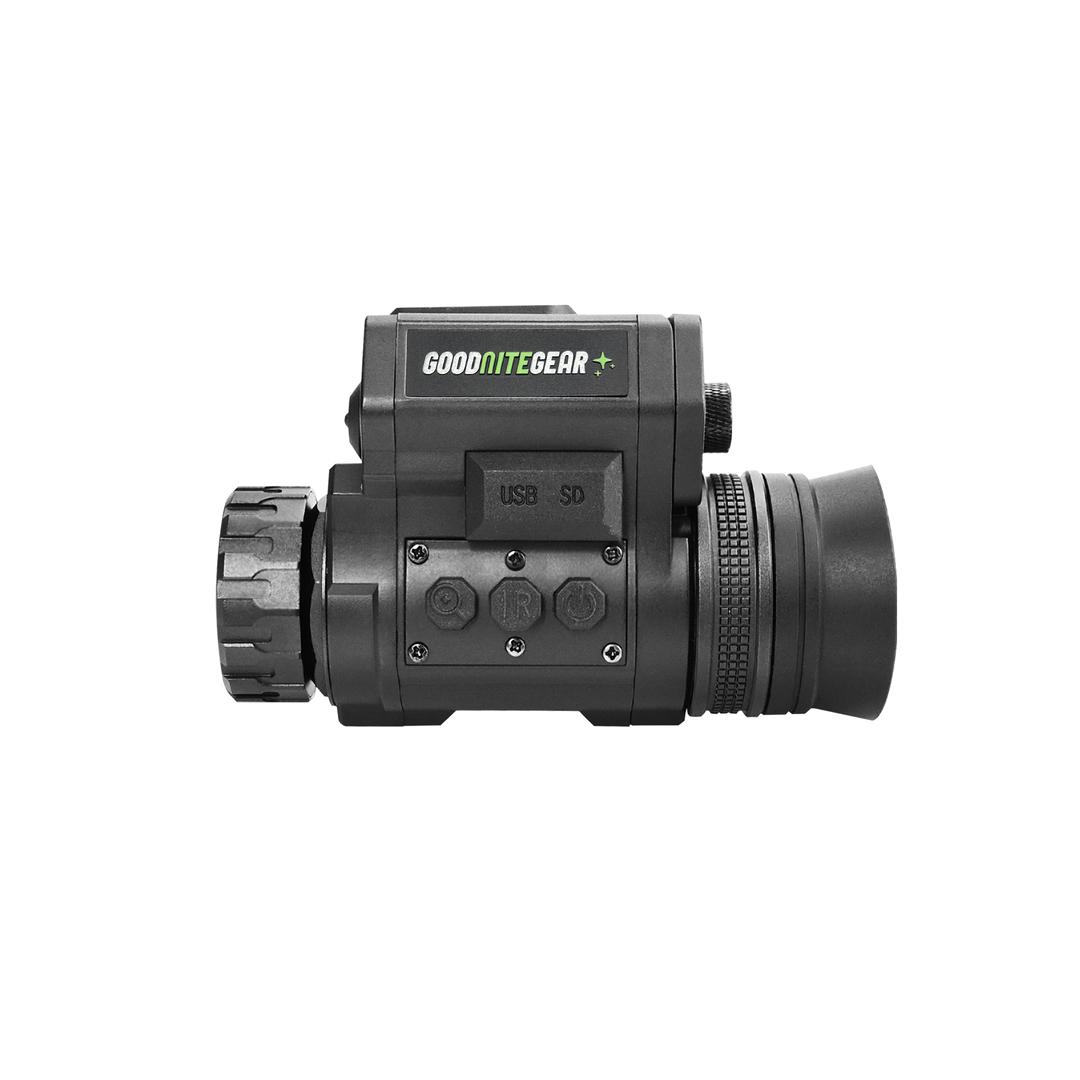
Up front, a high-quality objective lens rotates for precise focus adjustment. Behind it is the centerpiece of the whole system: a 1-inch Progressive Scan CMOS sensor. We'll get into what that sensor delivers in a moment, but the short version is that sensor size and type is the single biggest driver of low-light performance, and a 1-inch Progressive Scan chip in a sub-$1,000 device is not something you see every day.
Below the lens sits the IR illuminator, with the power and UI control knob directly beneath it. At the eyepiece end, a rotating diopter adjustment lets you dial the image to your eye, and inside is a Micro OLED 0.5-inch display running at 800x600 resolution. The image is black and white — as you'd expect from a night vision device — though the UI icons render in color, which helps with usability in the dark.

The Optical Zoom Knob: A Genuine Differentiator
One feature that sets the SVG5 apart from most digital night vision in this range: the analog zoom knob on the front of the unit. Rotate it and you get smooth, continuous optical zoom up to 5x. No button presses, no menu navigation — just turn the knob.
More importantly, the image holds up at zoom. Digital zoom on budget night vision devices typically produces a soft, grainy image past 2x that's barely usable for target identification. The SVG5's optical zoom stays sharp through the range, which makes 5x a practical tool for extended observation and target identification — not just a spec on a box.
This is also one of the clearest advantages digital night vision has over analog. A traditional image intensifier tube has a fixed focal length with no zoom capability. The SVG5 gives you 1x through 5x in one device, with image quality that holds. For hunters, security professionals, or anyone doing extended observation work, that flexibility matters.
Performance: What the 1-Inch Sensor Delivers
The SVG5 runs at both 50 and 100FPS. At 100FPS, latency is negligible — movement feels natural whether you're on foot, in a vehicle, or working at speed in a training or operational context. This matters more than most buyers account for when they're comparing specs on paper.
Field of view comes in at 43 degrees — wider than most devices in this class, and wider than several devices that cost significantly more. Combined with the taller aspect ratio of the display, you get more vertical coverage than narrower rectangular screens offer. The result is a setup that's genuinely comfortable for navigation and movement, not just stationary observation.
Battery runs on a single 18650 cell for 6–8 hours depending on settings — IR illuminator use and screen brightness are the main variables. 18650s are widely available, inexpensive, and easy to swap in the field, so the lack of onboard USB charging is a non-issue for most users.
Head-to-Head Comparisons
SVG5 vs. Higher-Priced Devices
This is where the SVG5's story gets compelling. In stepped no-IR low-light testing at 100FPS. Here's a link to the full video breaking these down: https://youtu.be/f_rwzfpNQto
The Sionyx Opsin retails for around $1,900 — nearly double the SVG5's price. In direct comparison, the SVG5 matches the Opsin's low-light output at most brightness levels, with a slight edge actually going to the SVG5 in the lower-light conditions. That result alone is worth sitting with.
The NVG90 (~$1,250) at 100FPS shows a step up in low-light performance over the SVG5, and the NVG90 SE (~$1,700) pushes it a bit further still. Neither is a blowout — the SVG5 is competitive with devices at $250–$700 more, which is not what the pricing suggests.

SVG5 vs. Budget Devices
Against sub-$1,000 options — including the Nightfox Prowl 2 at 60FPS, the NVG50 at 40FPS, and the NVG40 at 40FPS — the gap is much clearer. At reduced light levels where the budget devices are barely pulling an image, the SVG5 maintains a clean, usable picture. Add in the wider field of view, taller screen aspect ratio, and 5x optical zoom, and the performance difference is significant across the board.
For reference, a Gen 2+ analog tube also appeared in this test. The SVG5 holds up well against it — a comparison that would have been unthinkable for a sub-$1,000 digital device just a few years ago.

Here's another comparison of this device with a Gen2+ PVS14:
Menu and Controls
The UI is controlled via the knob on the front of the device. It's a short menu that covers what you actually need:
- Screen brightness adjustment
- IR illuminator toggle and power level
- FPS switching (50 or 100)
- Photo and video capture
- Screen flip
- Disk format, language, date/time
No bloat, no buried settings you'll never use. The device has internal memory for photo and video storage, with a port on the body for direct transfer to a computer.
Mounting
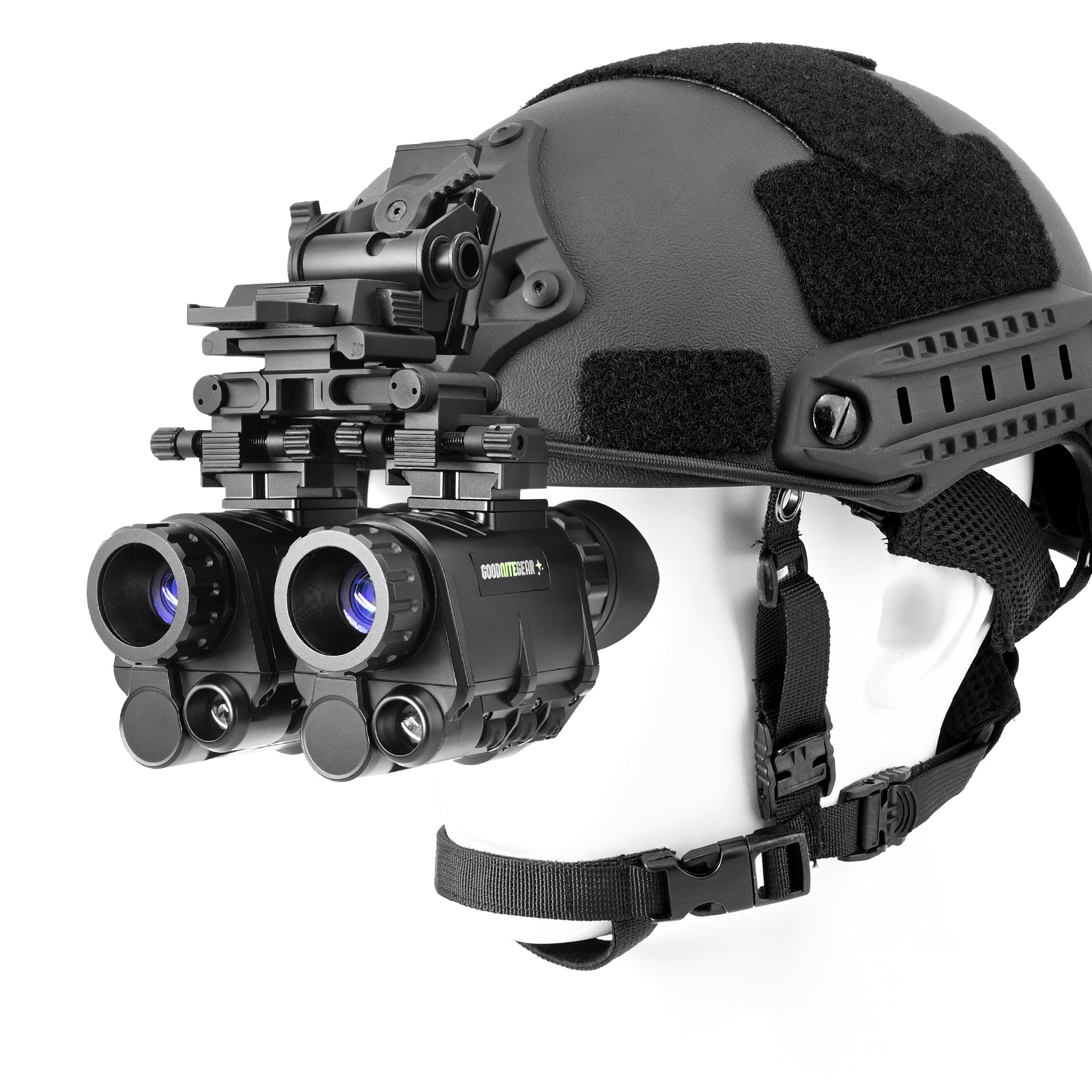
The SVG5 ships with a dovetail mounting arm on top that connects to a standard G24 mount. The arm is metal and mounts over either eye, which gives you flexibility in how you configure it on a helmet. There's a small amount of play in the connection — noticeable but not a dealbreaker — and it's consistent with what you see across most devices in this class.
Who Should Buy the GNG SVG5?
The SVG5 is the right choice for buyers who:
- Want the best low-light performance available in digital night vision under $1,000
- Need genuine optical zoom for extended observation or target identification
- Are stepping up from a budget device and want a meaningful performance jump
- Are considering the NVG90 or similarly priced devices but want to understand where the SVG5 sits before committing more budget
- Need IP67-rated durability for field conditions that rule out less robust devices
If your budget stretches to the NVG90 or NVG90 SE, the additional low-light headroom is real and worth considering for demanding use cases. But if $1,000 is your ceiling, the SVG5 doesn't leave you wishing you'd spent more — and that's not something you can say about many devices at this price.
Bottom Line
The GNG SVG5 is the best digital night vision device under $1,000 available right now. Metal housing, IP67 rating, a 1-inch Progressive Scan CMOS sensor, 43-degree field of view, 100FPS, and 5x optical zoom — at a price point that competes with hardware costing nearly twice as much. It's not a compromise buy. It's a serious device that happens to fit a budget.
Ready to pick one up? Shop the GNG SVG5 at Good Nite Gear and use code US10 at checkout to save 10%. If you want to see exactly how it stacks up against the NVG90, NVG90 SE, and other devices in the lineup, the full comparison video is linked on the channel.

