



What Are Quad NVGs? Everything You Need to Know About Panoramic Night Vision
If you've spent any time in the night vision world, you've seen quad NVGs in special operations footage — four tubes stacked on a helmet, delivering a view of the night that standard binos simply can't match. They look impressive. They perform at a level most NV devices can't touch. And until recently, they were financially out of reach for anyone outside a military unit with a procurement budget. Here's exactly how quad NVGs work, why they exist, and what your options actually look like in 2025.
What Are Quad NVGs?
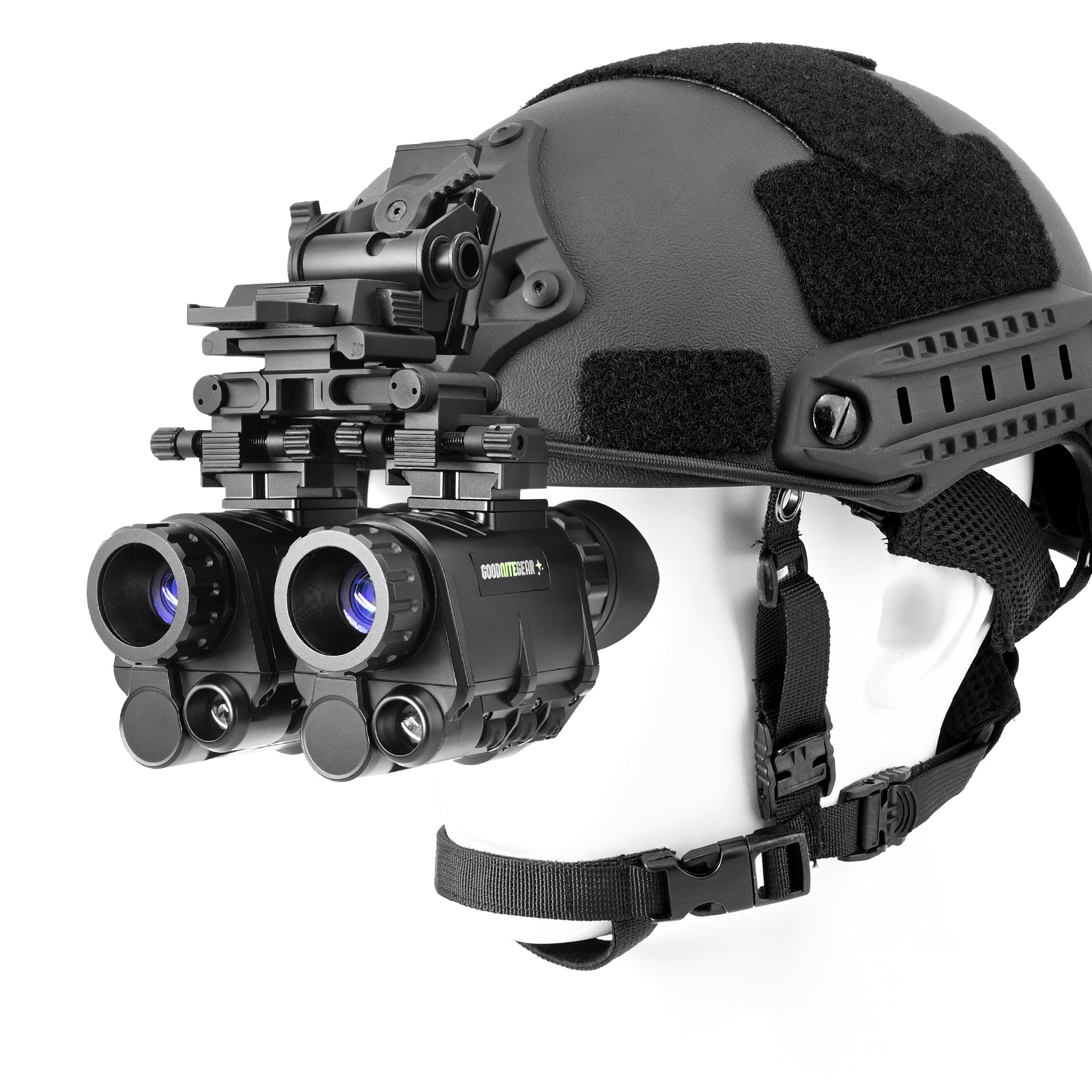
Quad NVGs — also called quad nods, panoramic night vision goggles, or PNVGs — are night vision systems that use four image sensors or tubes instead of the traditional one or two. The defining feature is field of view: while a standard monocular gives you roughly 40° of horizontal vision and a standard binocular gives you the same 40° with depth perception, quad NVGs expand that to 97°–120° of continuous panoramic coverage.
That's not a marginal improvement. Going from 40° to 120° is the difference between looking through a cardboard tube and actually seeing the environment around you.
How Quad NVGs Work
The four-tube layout isn't just about adding more sensors and hoping for the best — the geometry is deliberate.
The Tube Layout
Two central tubes point directly forward, exactly like a standard binocular. They handle your primary forward vision and provide stereoscopic depth perception. Those two don't change your experience much compared to a good set of binos.
The two outer tubes are what make quads a different category of device. They angle outward — typically 30° or more off-center — capturing the peripheral field that your central tubes miss entirely. The angle is calibrated to overlap slightly with the central tubes at the edges, creating a seamless blend rather than a hard seam in your image.
Image Blending
The inner and outer images are merged optically via prisms (on analog systems) or digitally via sensor fusion (on digital systems like the GNG G18). Done well, you don't perceive four separate images — you perceive one wide, continuous view of your environment. Done poorly, you get visible seams and a disorienting split-screen effect. This is one of the key quality differences between serious quad systems and cheaper alternatives.
What 120° Actually Feels Like
Standard binoculars give you tunnel vision. You see what's directly in front of you well, and you scan to compensate. With quad NVGs, you can track movement in your peripheral field without turning your head. You catch the person stepping out from cover at your 10 o'clock without looking away from your primary target. In a vehicle, you can monitor your lane, the shoulders, and approaching hazards without constant head movement. It's a fundamentally different experience — and once you've run quad, going back to binos feels like a handicap.
Why Quad NVGs Were Developed
Quad NVGs didn't start as a consumer product. They were developed for Tier 1 military applications where the cost of missing peripheral information is measured in lives. High-speed vehicle operations, helicopter aviation, and close-quarters battle (CQB) are the three environments where 40° FOV creates the most dangerous blind spots.
The L3Harris GPNVG-18 — the analog quad system that's been standard kit for special operations units — became widely known after footage from the Neptune Spear raid surfaced. Since then, quad NVGs have become the reference point for serious NV capability in the tactical community.
The problem: the GPNVG-18 costs $40,000 to $50,000. That's not a misprint. For analog quad systems at the high end of tube quality, that's the real price. For most operators, law enforcement units, and serious enthusiasts, quad capability has been something you admire from a distance.
The Trade-offs of Running Quad
Quad NVGs aren't for everyone, and it's worth being clear about the downsides before you decide this is your next step.
Weight. Four tubes — or four sensors — means a heavier system on your head. Analog quad systems can push 800g–1,000g for the goggle unit alone, requiring a counterweight on your helmet to stay comfortable over time. The GNG G18 comes in under 640g for the goggle unit, which is competitive, but it's still a meaningful step up from a standard binocular setup.
Cost. Even at the accessible end of the market, quad NVGs represent a serious investment. Analog systems start at $40,000. The GNG G18 brings digital quad capability to $8,950 — a major shift, but still not an impulse purchase.
Complexity. Quad NVGs require more setup, more helmet real estate, and more maintenance than a standard monocular or binocular. If you're not comfortable with your current NV system, adding quad complexity isn't going to help.
Not a beginner purchase. This comes up constantly, and it's worth saying directly: if you haven't run a binocular NV setup and gotten comfortable with it, quad is not your next step. Start with a monocular or bino, learn your system, then decide if quad is actually what you need.
The GNG G18 — Digital Quad NVGs at a Fraction of Analog Cost
The GNG G18 is the only serious digital quad NVG system at its price point. Rather than four analog image intensifier tubes, it's built around a 1-inch solid-state imaging sensor with a spectral response range of 400nm to 1100nm and a minimum illumination rating of 0.00005 lux — which means clean starlight imaging with no IR illuminator required.
The 120° horizontal FOV is delivered through an F/1.2 aperture on a 19.8mm objective lens, with an 8mm exit pupil and 21mm of eye relief. Image resolution and OLED display resolution are both 800×600, matched to prevent any loss between sensor and display. Frame rate runs at 50Hz or 100Hz standard, with 60Hz/120Hz available on custom configuration.
On battery life, the G18 runs four 18650 rechargeable lithium cells for over 22 hours of continuous operation. Charging is via USB-C. IP67 weatherproofing handles full dust immersion and water submersion. Operating temperature covers -20°C to 55°C standard, expandable to -40°C to 60°C.
It mounts on a standard Wilcox interface — the same ecosystem used by professional analog quad systems — and boots in under 4 seconds.
For detection and recognition, the published DRI numbers are:
- Human detection: 935m / Recognition: 468m / Identification: 234m
- Vehicle detection: 1,265m / Recognition: 633m / Identification: 316m
These are honest, published specs — not marketing language.
One thing to know before ordering: the G18 carries a 6–8 week lead time from order placement to delivery. Plan accordingly.
Who Should Buy Quad NVGs
If any of these describe you, quad NVGs are worth serious consideration:
- You're already running a binocular NV setup and hitting the limits of 40° FOV
- You operate in vehicles, aviation, or CQB environments where peripheral awareness is mission-critical
- You're a law enforcement unit looking to equip personnel with panoramic capability
- You want the closest thing to Tier 1 capability at a price that's actually accessible
If you're earlier in your NV journey, start with a solid binocular setup first — the NVG90 or NVG30 binocular kit is the right step before quad.
Questions about whether quad NVGs are the right move for your setup? Contact us — we'll give you a straight answer.

